

Business Services
Tax Consulting
Well-founded, individual tax consulting for companies and individuals. Benefit from optimized tax strategies, clear recommendations for action, and secure compliance in a dynamic tax environment.
VAT
Value added tax in Switzerland is levied at a standard rate of 8.1%. A reduced rate of 3.7% applies to overnight stays including breakfast, a reduced rate of 2.5% for food, medicine, newspapers, and books. Health, education, culture, and real estate are exempt from VAT.
Everyone must make a financial contribution for the state to function, and value added tax (VAT) is a means of ensuring that everyone who consumes something contributes. It would be too complicated if every consumer had to pay taxes. That's why companies take responsibility by including VAT in the price they charge their customers or showing it as a separate item on invoices.
Register and File VAT Online
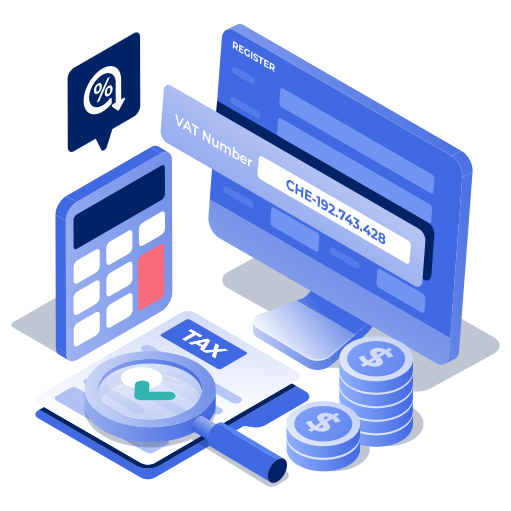
Value added tax (VAT) is a consumption tax levied on the sale of goods and services in Switzerland. Companies subject to VAT must register with the Federal Tax Administration (ESTV). The registration process is done online.
VAT Obligation
As a company, you are subject to VAT if your annual turnover exceeds CHF 100,000. This means you must register with the Federal Tax Administration and declare your sales every year. Upon registration, you will be assigned a VAT number.
This also applies to companies based abroad if they provide services in Switzerland.
VAT Accounting Methods
The flat rate tax is the most common way to settle VAT in Switzerland. In this case, you determine the VAT liability for a period based on total turnover.
The effective accounting method is the other way to settle VAT in Switzerland. In this case, input tax and sales tax are recorded separately.
Tax Canton
Federal Government
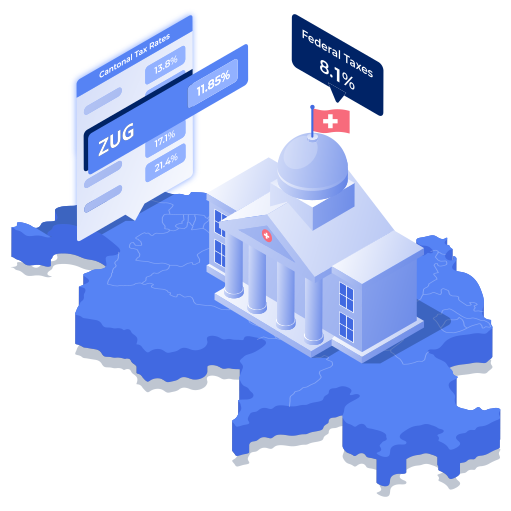
The federal government has enacted the Direct Federal Tax Act, which ensures that companies and cooperatives pay their fair share. The set rate of 8.5% is a small price for national prosperity, as taxes are used by the cantons under federal supervision to fund useful public projects throughout Switzerland.
Canton
Each of Switzerland's 26 cantons has the freedom to decide which taxes it levies and how. The federal constitution protects each state from intercantonal double taxation or unfair tax benefits by prohibiting certain levies and harmonizing direct taxes between states. The National Financial Equalization (NFA) also attempts to balance structural differences between cantons of different size, geography, or demographics in tax law.
Municipalities
In Switzerland, each municipality is entrusted with fulfilling various local tasks, such as social welfare and providing elementary schools. To finance these tasks, taxes are levied in accordance with cantonal regulations.
Tax Calculation
Calculating taxes on a specific profit can be complicated because the tax rate is different for each canton. For most of Switzerland's 26 states and 6 half-cantons (OW, NW, BS, BL AR, etc.), it consists of legally fixed tax rates and additional amounts determined periodically based on taxable capital or income.
Tips for Canton Selection
Choosing the right canton for your legal entity requires extensive knowledge and research. Many companies blindly choose a popular location without considering all factors that could influence their decision-making process. Different areas have different advantages; Zug is very favorable for profit and wealth taxes, while other locations offer subsidies or incentives beneficial for startups. Take the time to carefully examine each option before deciding what's best for you!